Residence Consulting & Aging in Place

A home that understands how you live.

The most useful residence decisions begin with the person who will live with them. Pathfinder brings occupational therapy-informed understanding to the routines, movements and preferences that make a home personal. You and your residential team receive agreed functional priorities and written considerations to use while property, renovation or equipment choices are still open.

Bring us in while the question is open

Individuals, authorized families and representatives can commission this work before a purchase, renovation, move between homes or return after a care transition. Architects, interior designers and estate managers can introduce a specific question with the client's agreement.

Healthy clients seeking a more personal fit are welcome, as are people adapting to changing needs. The starting point is the life you want at home: reading privately, hosting friends, preparing a meal or moving between familiar spaces with your preferred level of assistance.

What the consultation makes clearer

Within the agreed scope, Pathfinder provides person-specific observations, prioritized concerns, written information and questions for the appropriate team. These can inform comparisons between available arrangements and identify matters needing closer professional review before a solution is selected.

For a defined residential design question, a scoped Functional Design Assessment may lead to a Functional Design Brief for the agreed recipients. Other residence consultations retain the outputs appropriate to their purpose. Your architect or designer receives relevant functional considerations; an estate manager or household team receives agreed preparation priorities.

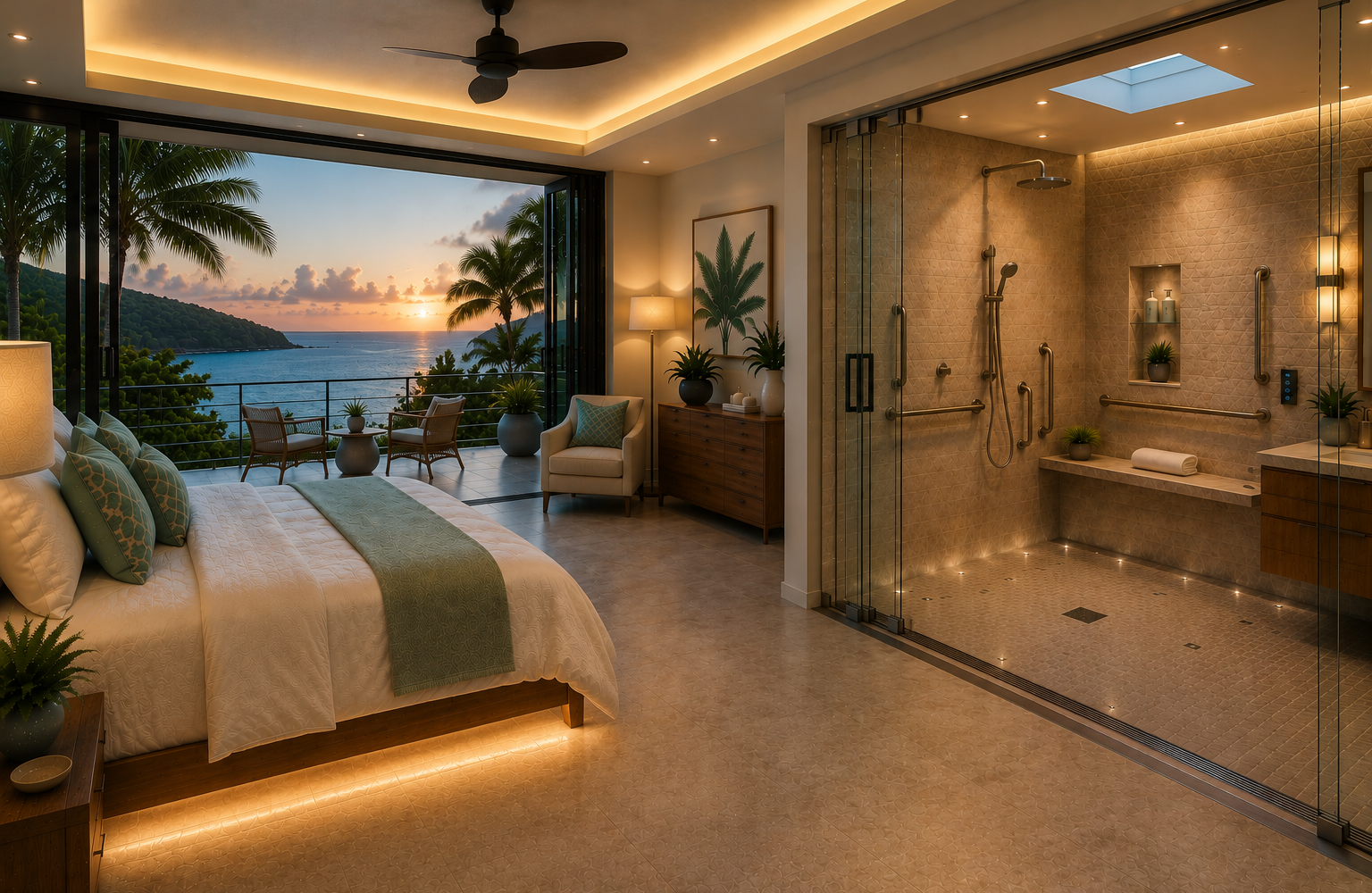
Refined private residence interior showing a walkway, level transition, and circulation space

A beautiful room can serve several activities differently. We connect relevant details rather than treating a feature as suitable for everyone. Depending on the question, this can include entrances, stairs, thresholds and circulation; bathing, kitchen and bedroom routines; equipment placement and storage; and the positioning of a caregiver or companion. These practical access and assistance considerations sit alongside the preferences that make a home personal.

Movement
How position, reach, hand use and endurance relate to surfaces and objects.
Sensation
The person's experience of light, reflections, sound, touch and temperature.
Attention
Finding items, following conversation and moving between parts of a task.
Routine and meaning
Familiar rituals, duration, privacy and the choice to accept or decline help.

An illustrative example: a place for the reading hour

Activity
A client wants to read beside a window in a renovated sitting room.
Human insight
The preferred seat, changing light, page position and reach to a drink all shape that hour; the familiar place may also offer valued privacy.
Decision
Which seating, nearby surface and lighting relationships should the team compare?
Recipient
The interior designer and relevant lighting professional receive those considerations in the agreed written output. The client can explain what makes the reading place worth preserving, beyond its appearance.

This is an illustration, not a reported client outcome.

Personal understanding, alongside your team

Pathfinder's NOETELIER™ perspective informs functional design advisory: advanced human understanding for bespoke environments. NOETELIER is Pathfinder's proprietary professional designation; Taylor Azua's OTR credential provides the occupational therapy foundation.

We agree what information is shared with your chosen team. Architects, designers, contractors and equipment professionals evaluate and implement solutions within their disciplines; Pathfinder contributes the person's functional context. Tell us about the routine and the choice ahead, and we can discuss whether a consultation would be useful.

Common questions

Frequently asked questions

What’s the difference between an aging-in-place consultant and a home accessibility contractor?
A home accessibility contractor installs and builds — grab bars, ramps, widened doorways, walk-in showers. An aging-in-place consultant like Pathfinder identifies the person-specific functional priorities first — how someone actually moves, transfers, and lives in their home — before any construction decision is made. Contractors, architects and equipment professionals evaluate the recommendations and retain responsibility for their own work.
Do you provide the renovation or install the equipment?
No. Pathfinder’s role is functional assessment and guidance; we work alongside your contractor, architect, or equipment vendor rather than performing that work directly.

Discuss how your residence needs to function

Tell us about the routine and the choice ahead. We can discuss whether a consultation would be useful and what the scope might include.

Discuss your residence

Residence planning can also be part of a broader private client engagement. Learn about Private Client Care Navigation & Family Office Advisory